
Federal AI Order Stalls While California Moves Ahead
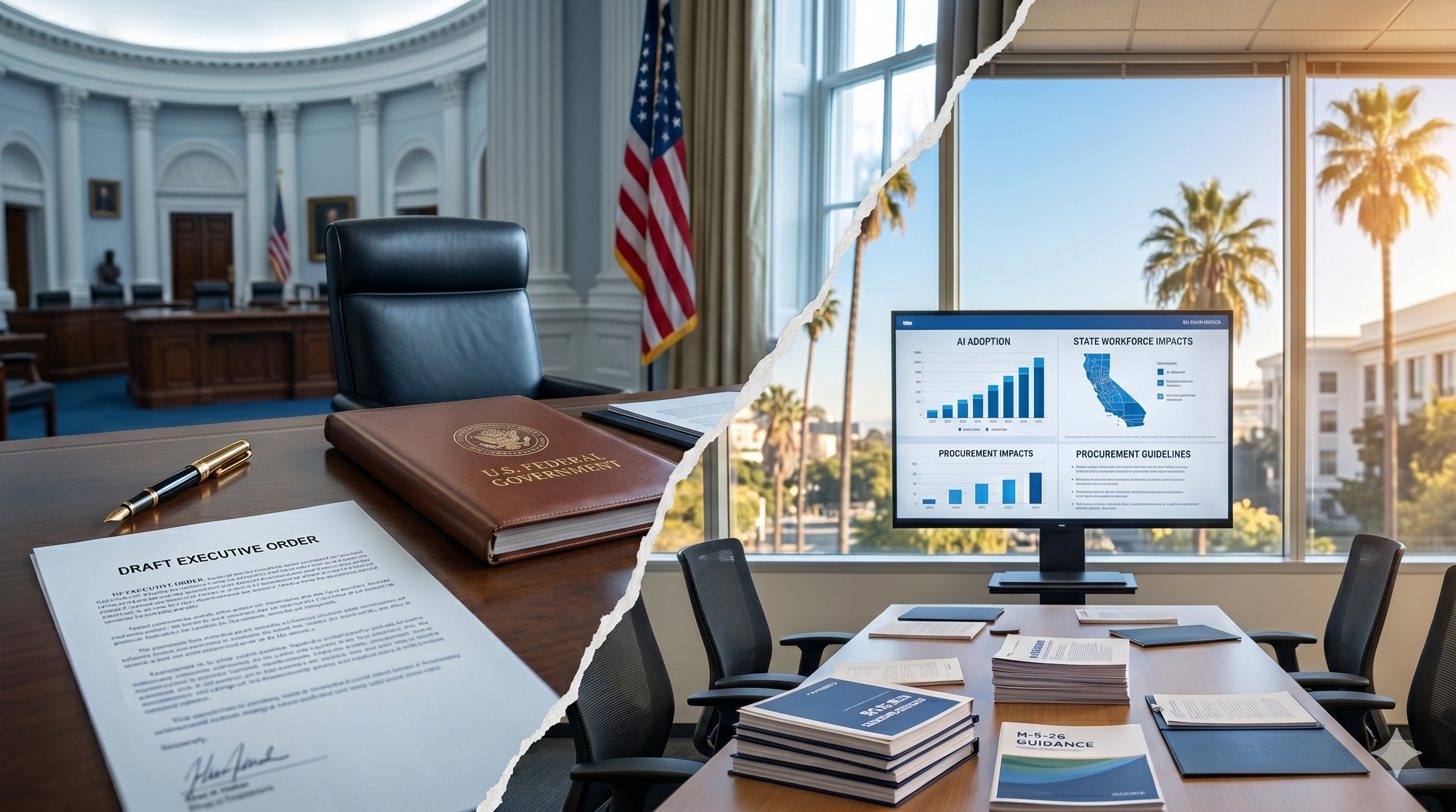
The past week underscored how unsettled AI policy remains in the U.S. and how differently Washington and Sacramento are using executive orders.
The Federal AI Executive Order That Didn’t Happen
The White House had planned to roll out a new AI executive order but pulled back at the last minute.
Key points:
President Trump was expected to sign an order creating a voluntary framework for government review of advanced (“frontier”) AI models before public release.
The draft reportedly would have:
Directed agencies to strengthen AI‑related cybersecurity.
Encouraged testing and evaluation of cutting‑edge systems in partnership with leading AI developers.
Hours before the ceremony, the signing was cancelled, with the President citing concerns that additional oversight could slow innovation and weaken U.S. competitiveness in AI.
This episode sits on top of existing federal actions:
A late‑2025 executive order aiming to limit state‑by‑state AI regulation and promote a nationally uniform approach.
The March 2026 National Policy Framework for Artificial Intelligence, which:
Emphasizes federal preemption of broad state AI rules.
Favors relatively light federal intervention in AI development, while leaving Congress to decide whether to go further.
For now, there is no new federal order expanding AI oversight beyond that framework and prior directives.
California’s AI Executive Orders
California, by contrast, is layering in AI policy through multiple executive orders.
First wave (2023):
Executive Order N‑12‑23 directed state agencies to:
Study the development, use, and risks of generative AI.
Assess impacts on privacy, safety, civil rights, and state operations.
Develop a “deliberate and responsible” process for deploying AI in state government.
Procurement and oversight (2026):
Executive Order N‑5‑26 uses state purchasing power to shape AI practices.
It instructs agencies such as:
The Department of General Services.
The California Department of Technology.
Core directions include:
Building new certification and attestation requirements into AI‑related contracts.
Addressing harmful or illegal content, bias, and civil rights impacts in AI systems.
Developing guidance on provenance or watermarking for AI‑generated content.
Allowing state officials to independently assess AI‑related supply chain risks.
Workforce focus:
A separate May 2026 order directs state entities to:
Analyze AI’s effects on workers and key industries.
Propose strategies for training, upskilling, and managing workforce transitions.
Where Things Stand Now
In practical terms:
Federal:
The Administration has a national AI framework and a clear interest in preempting broad state AI rules.
It has not yet finalized the additional AI executive order that was set for signature last week.
California:
Is using executive orders to:
Study AI risks.
Set expectations for how state agencies deploy AI.
Embed AI oversight into procurement and workforce planning.
CPRA Strategies will continue to monitor federal and California AI executive actions, as well as related legislative activity, to help public agencies, nonprofits, and businesses understand how this emerging AI policy landscape may affect their programs, compliance obligations, and future funding opportunities.
