
Marijuana to Schedule III: What DOJ’s Order Means for California
DOJ’s Schedule III order creates major tax and regulatory changes for California’s cannabis industry.

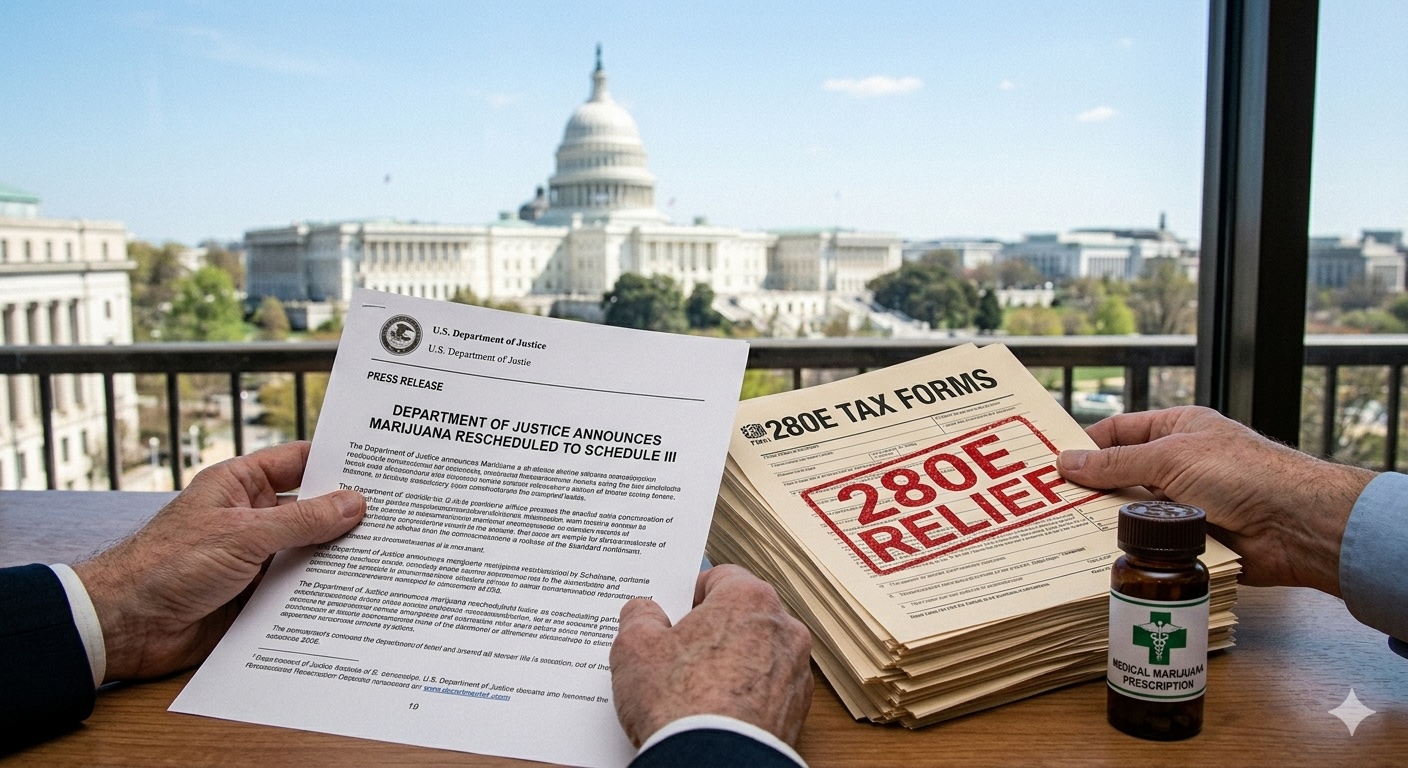
This morning, the Justice Department confirmed a big shift: Acting Attorney General Todd Blanche has signed a final order that moves two categories of marijuana from Schedule I to Schedule III of the Controlled Substances Act, effective April 22, 2026.
The move is already being described as the most consequential federal cannabis policy change in more than fifty years—and for once, that’s not just hype.
What actually changed
The order immediately places into Schedule III:
- FDA‑approved drug products containing marijuana, and
- Marijuana products regulated under a qualifying state medical marijuana license.
That’s it. Adult‑use stays outside the tent.
Because Internal Revenue Code Section 280E only applies to trafficking in Schedule I or II substances, state‑licensed medical operators and FDA‑approved marijuana products that fit inside this new Schedule III bucket are no longer subject to 280E going forward. That means ordinary business deductions are finally back on the table for qualifying medical activity—a huge shift for operators who have been paying federal tax on something like gross revenue.
At the same time, DOJ and DEA are launching a new, expedited administrative hearing process on June 29 to consider whether marijuana more broadly should move to Schedule III. So this “medical first” move is only phase one.
What didn’t change
Just as important is what the order does not do.
- It does not legalize marijuana federally. Products and activity outside the FDA‑approved and qualifying state medical lanes remain in Schedule I for now, with all the same criminal, civil, and administrative consequences under the Controlled Substances Act.
- It does not touch adult‑use markets. California’s adult‑use operators—who make up most of the state’s legal cannabis economy—get no direct relief. They are still federally illegal and still stuck with 280E.
- It does not rewrite state law. DOJ is leaning on existing state medical frameworks rather than building a full federal bureaucracy overnight, but California’s Department of Cannabis Control still runs the show on licensing and day‑to‑day compliance.
Why this matters for California
For years, California has treated medical and adult‑use licenses as cousins in a unified system. Now Washington suddenly cares a lot about the difference.
- Medical licenses now carry a federal upside. Schedule III status and 280E relief make medical‑focused operations more attractive overnight.
- Adult‑use is left behind—for now. The same company could have medical activity that qualifies for Schedule III treatment and adult‑use activity that stays stuck in Schedule I. That’s going to be a compliance and tax headache inside one state framework.
- Research should get easier. By explicitly putting FDA‑approved marijuana medicines and qualifying state medical products into Schedule III and starting an expedited broader rescheduling process, DOJ is trying to clear a path for more clinical and academic work with marijuana.
None of this is the end of the story. The legal theory behind the order is aggressive enough that litigation is widely expected, and Treasury still has to decide how to handle the tax ripple effects, including any retroactive 280E relief.
For California, the next chapter is less about celebrating a headline and more about sorting out how a unified state system functions when the federal government suddenly treats “medical” and “adult‑use” as very different worlds.